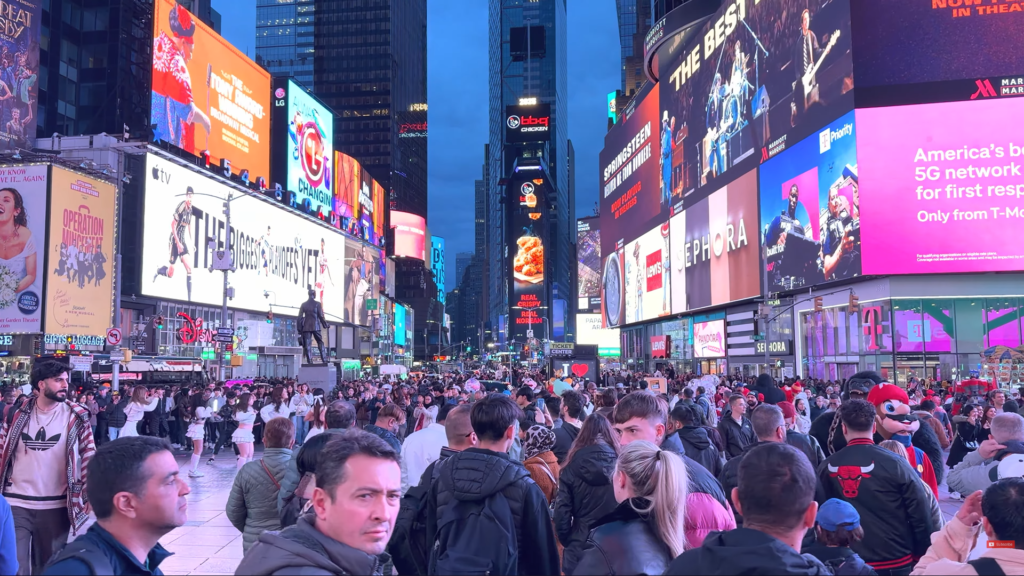
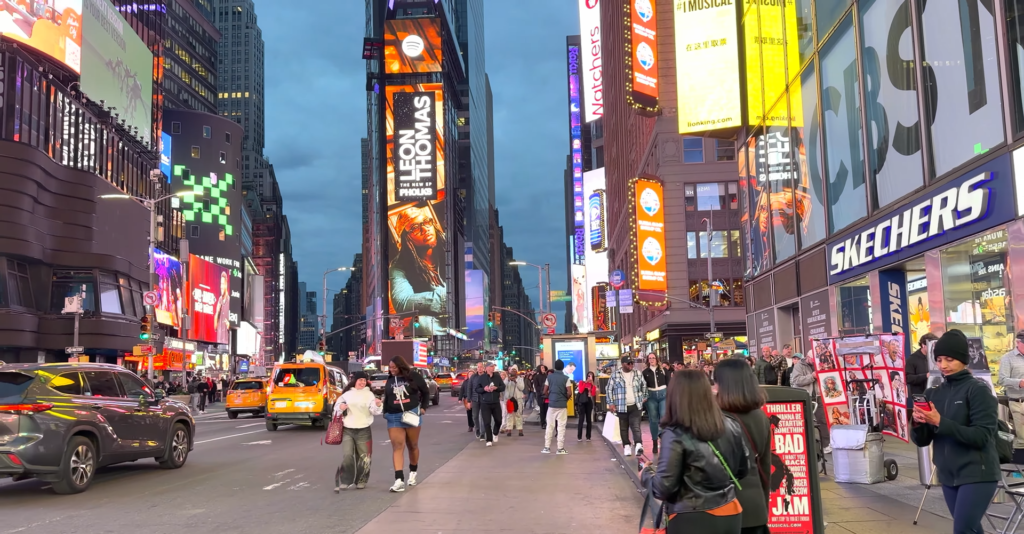
Times Square is one of the most recognizable places on Earth. Neon lights, towering digital billboards, Broadway theaters, street performers, New Year’s Eve celebrations watched by millions — it feels timeless, inevitable, as if it was always meant to exist exactly as it does today. But the name “Times Square” is not ancient, symbolic, or poetic in origin. In fact, it is surprisingly specific, practical, and rooted in a single decision made just over a century ago by a newspaper publisher.
To understand why it is called Times Square, you have to strip away the modern spectacle and travel back to a very different New York City — one without skyscrapers of glass and LED screens, without Broadway superstardom, and without the global fame that now defines this intersection. What we now call Times Square was once an unremarkable patch of Manhattan known by another name entirely.
Table of Contents
Before Times Square Existed
In the early 19th century, the area that would eventually become Times Square was far removed from the heart of New York City. Manhattan’s population was concentrated much farther south, and the northern reaches of the island were semi-rural, dotted with farms, horse stables, small businesses, and dirt roads. The intersection of what would later become Broadway and Seventh Avenue was not a cultural center; it was simply a crossroads.
This area was originally known as Longacre Square, a name borrowed from London’s Long Acre district, which was famous for carriage manufacturing and horse-related trades. New York’s Longacre Square served a similar purpose. It was a working district, home to carriage makers, blacksmiths, and stables, catering to a city that still relied heavily on horse-drawn transportation.
At this time, there was nothing particularly glamorous about Longacre Square. It was noisy, industrial, and utilitarian. No one could have predicted that it would one day become a symbol of entertainment, media, and global culture.
The Rise of Newspapers and the Power of Media
To understand how Longacre Square became Times Square, you must understand the enormous influence newspapers held at the turn of the 20th century. This was the golden age of print journalism. Newspapers were the primary source of information, shaping public opinion, politics, and culture in ways that social media and television would much later replicate.
Among the most powerful newspapers in the United States was The New York Times. Founded in 1851, the paper had built a reputation for serious journalism, intellectual rigor, and credibility. By the early 1900s, it was already one of the most respected newspapers in the country.
In 1896, Adolph S. Ochs purchased The New York Times. Ochs was a visionary publisher who believed that journalism should be factual, restrained, and authoritative. Under his leadership, the paper grew rapidly in influence and readership. But Ochs wanted more than editorial prestige — he wanted a headquarters that symbolized the paper’s power and modernity.
A Strategic Move Uptown
At the beginning of the 20th century, most major newspapers were headquartered downtown, near City Hall. But Manhattan was changing quickly. Transportation improvements, particularly the expansion of subway lines, were pushing the city northward. Adolph Ochs recognized that the future of New York was moving uptown, and he wanted The New York Times to move with it.
In 1903, Ochs decided to construct a new headquarters at the heart of Longacre Square. This was a bold and unconventional decision. Many thought the location was too far north, too undeveloped, and too risky. But Ochs believed that anchoring the area with a major institution would transform it.
The building, officially known as the Times Tower, was completed in 1904. Rising 25 stories high, it was one of the tallest structures in the city at the time and an unmistakable symbol of modern ambition. When The New York Times moved into the building, it immediately changed the identity of the surrounding neighborhood.
The Renaming of Longacre Square
The most pivotal moment in the history of Times Square came later in 1904, shortly after the newspaper relocated to its new headquarters. Adolph Ochs petitioned the city to rename Longacre Square in honor of his newspaper.
The city agreed.
On April 8, 1904, Longacre Square officially became Times Square.
This was not merely a ceremonial gesture. Naming a public square after a private newspaper was highly unusual, even controversial. But the city recognized the economic and cultural impact the Times Tower was already having on the area. The new subway station built beneath the square further cemented its importance, making Times Square a major transportation hub almost overnight.
The name “Times Square” was literal, direct, and unapologetic. It referred specifically to The New York Times, not to time itself, clocks, or chronology — although those associations would later emerge symbolically.
New Year’s Eve and the Birth of a Tradition
One of the most enduring associations with Times Square — the New Year’s Eve celebration — also traces directly back to The New York Times.
To celebrate the opening of its new headquarters in 1904, the newspaper organized a massive public event on December 31. Fireworks were launched from the Times Tower, and tens of thousands of people gathered in the square to ring in the new year. The event was such a success that it became an annual tradition.
A few years later, when fireworks were banned due to safety concerns, the celebration evolved. In 1907, a glowing ball was lowered from the top of the Times Tower at midnight, marking the beginning of the new year. This “ball drop” became iconic, transforming Times Square into the symbolic center of New Year’s Eve not just for New York, but for the entire nation — and eventually, the world.
Though The New York Times would later move its headquarters, the traditions it established remained permanently tied to the square that bore its name.
The Newspaper Leaves, but the Name Remains
In 1913, less than a decade after moving into the Times Tower, The New York Times outgrew the building and relocated its headquarters to West 43rd Street. The original tower was later renamed One Times Square.
Despite the newspaper’s departure, the name “Times Square” remained. By then, it had taken on a life of its own. The area had become synonymous with entertainment, nightlife, and spectacle. Broadway theaters multiplied, electric signs began to dominate building facades, and Times Square evolved into a dazzling urban stage.
Ironically, the building that once housed a serious, restrained newspaper became best known not for journalism, but for hosting massive advertisements and the New Year’s Eve ball drop. Today, One Times Square is mostly empty inside, serving primarily as a billboard tower — a striking metaphor for how the square itself transformed over time.
From Journalism to Entertainment Capital
The name “Times Square” may have originated from a newspaper, but its meaning expanded far beyond journalism. By the 1920s and 1930s, Times Square had become the heart of American entertainment. Broadway flourished, movie palaces opened, and the area buzzed with energy at all hours.
Electric signs, once a novelty, became a defining feature. Times Square was among the first places in the world where illuminated advertising dominated the skyline. This visual intensity reinforced the square’s reputation as a place where news, entertainment, commerce, and culture collided.
During World War II, Times Square became a gathering place for soldiers and civilians alike. The famous photograph of a sailor kissing a nurse on V-J Day was taken here, further embedding the square into national memory.
Decline and Reinvention
The mid-20th century brought decline. By the 1960s and 1970s, Times Square had developed a reputation for crime, pornography, and urban decay. The glamour faded, and many avoided the area altogether. Yet the name endured, carrying both the weight of its history and the promise of renewal.
Beginning in the 1990s, large-scale redevelopment transformed Times Square once again. Crime rates dropped, family-friendly attractions returned, and corporate media companies established a presence. Digital billboards replaced static signs, and the square reemerged as a global tourist destination.
Throughout every phase — growth, decline, and rebirth — the name “Times Square” remained unchanged, anchoring the area’s identity across generations.
Why the Name Still Matters
Today, many people assume that Times Square is named because it represents the passage of time, the countdown to midnight, or the pace of modern life. While those interpretations are poetic and fitting, they are not the origin of the name.
Times Square is called Times Square because The New York Times put itself there — physically, symbolically, and culturally. A newspaper’s decision to build a tower in an overlooked district reshaped Manhattan’s geography and altered the trajectory of the city.
The name endures because it tells a uniquely American story: how media, ambition, infrastructure, and urban growth intersected to create something larger than any one institution. It reminds us that places are not just shaped by geography, but by ideas, influence, and timing.
In that sense, Times Square is more than a name. It is a monument to the power of communication, the evolution of cities, and the unpredictable ways history unfolds.
And fittingly, for a place born from a newspaper devoted to recording history, Times Square has become one of the most photographed, visited, and remembered places in the world — forever frozen at the intersection of past, present, and future.