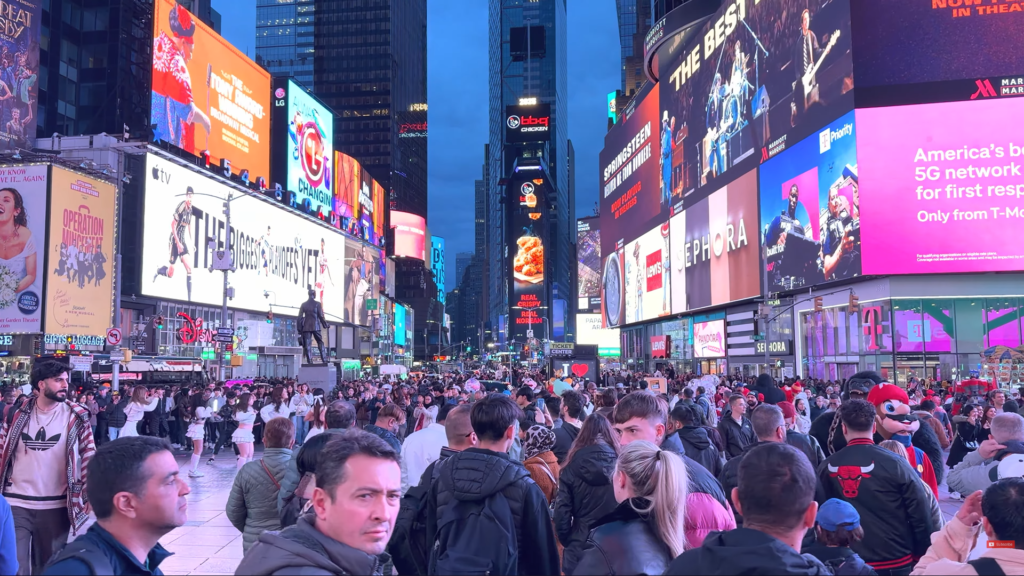
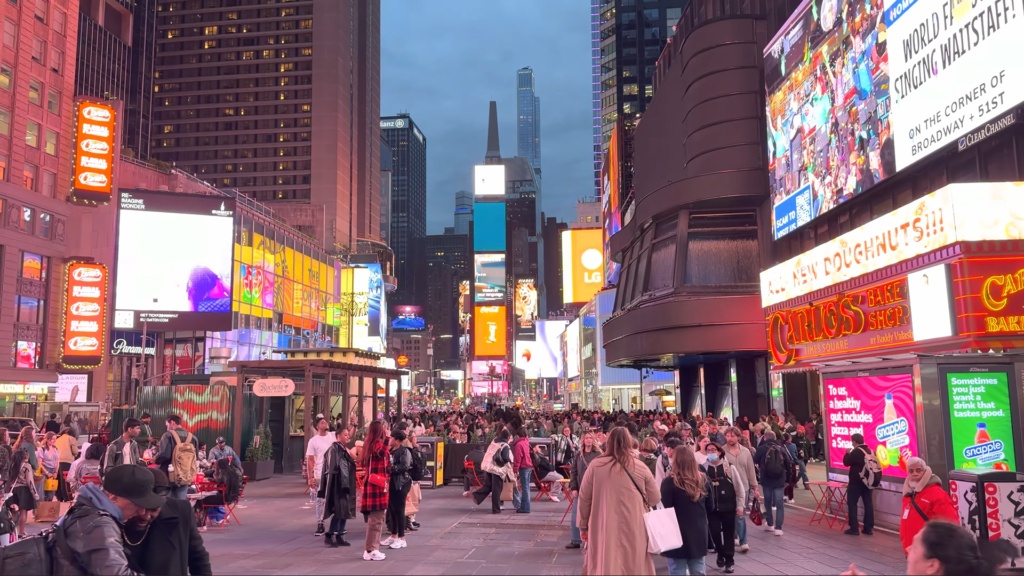
Times Square looks like a single, unified place. When people see it on television or visit it in person, it feels almost like one giant property — a glowing plaza controlled by a single authority, brand, or corporation. With its coordinated billboards, pedestrian zones, police presence, and carefully managed events, it’s easy to assume that someone, somewhere, owns Times Square outright.
But the truth is far more complex.
Times Square is not owned by one person, company, or organization. Instead, it is a carefully layered mosaic of public land, private property, corporate leases, city regulations, and nonprofit management. Understanding who owns Times Square requires unpacking how New York City itself works — legally, historically, and economically.
To answer the question properly, we need to separate land ownership, building ownership, public space control, and branding authority — because each belongs to different entities.
Table of Contents
Times Square as a Place, Not a Property
The first and most important thing to understand is that Times Square is not a single parcel of land. It is a name given to a district centered around the intersection of Broadway and Seventh Avenue, roughly spanning West 42nd Street to West 47th Street in Midtown Manhattan.
That means Times Square is not like a shopping mall or theme park that can be bought or sold. It is a publicly named area within New York City, similar to neighborhoods like SoHo, Harlem, or Wall Street. The streets themselves are public, owned by the city, while the buildings surrounding them are owned by a wide range of private entities.
So when people ask, “Who owns Times Square?”, the real answer begins with this clarification: no one owns Times Square as a whole.
Who Owns the Streets and Sidewalks?
The streets, sidewalks, plazas, and intersections that make up Times Square are owned by the City of New York. Broadway, Seventh Avenue, and all cross streets in the area are public rights-of-way, managed by the New York City Department of Transportation.
In 2009, parts of Broadway running through Times Square were permanently closed to vehicle traffic and converted into pedestrian plazas. These plazas, often mistaken for private squares, are still public land. They belong to the city, just like Central Park belongs to the city, even though daily operations may be managed by outside organizations.
This distinction is critical. You cannot buy Times Square because you cannot buy New York City streets. However, the city can regulate how those streets are used, who maintains them, and what activities are permitted there.
The Buildings Are Privately Owned
While the streets belong to the city, the buildings surrounding Times Square are privately owned, and this is where ownership becomes fragmented.
Every skyscraper, theater, hotel, office tower, and retail space in Times Square belongs to a different owner or investment group. Some are owned by real estate investment trusts, some by international property firms, some by pension funds, and others by private developers.
Major real estate companies such as SL Green Realty, Vornado Realty Trust, and RXR Realty own or control multiple properties in and around Times Square, but none of them own all of it. Ownership is divided building by building, sometimes even floor by floor.
Many properties are held through complex corporate structures, meaning the “owner” may be a holding company backed by investors from multiple countries. In some cases, ownership has changed hands dozens of times over the past century.
The Times Square Alliance and the Illusion of Ownership
One reason people believe Times Square has a single owner is because it is exceptionally well-managed. That role is largely handled by the Times Square Alliance, a nonprofit organization formed in the 1990s.
The Times Square Alliance does not own Times Square. Instead, it operates as a business improvement district, or BID. This means local property owners pay additional assessments, which fund services like sanitation, security coordination, marketing, and event management.
The Alliance helps maintain cleanliness, organizes New Year’s Eve celebrations, manages public seating areas, and coordinates with police and city agencies. Because its presence is so visible, many assume it is the “owner” of Times Square, but legally, it is a manager and steward, not an owner.
Who Controls the Famous Billboards?
The billboards are perhaps the most iconic feature of Times Square, and they contribute heavily to the confusion about ownership.
The giant LED screens, digital displays, and illuminated signs are privately owned and leased. Each billboard is attached to a building, and its ownership usually belongs to the building owner or a specialized advertising company leasing space from that owner.
Times Square has some of the most valuable advertising real estate on Earth. A single digital billboard can cost millions of dollars per year to rent. These revenues go to private landlords, not to the city directly, although the city benefits through taxes and tourism.
What makes Times Square unique is that zoning laws require buildings in the area to display illuminated signage. This means owners are legally obligated to maintain bright, animated signs, reinforcing the district’s visual identity. The city doesn’t own the signs, but it dictates the rules that shape how they look.
Theaters and Broadway Ownership
Broadway theaters in Times Square are also privately owned, often by major entertainment organizations such as the Shubert Organization, Nederlander Organization, and Jujamcyn Theaters.
These companies own the physical theater buildings, lease them to production companies, and control ticketing, scheduling, and renovations. Again, ownership is fragmented. No single entity controls all Broadway theaters, even within Times Square.
This patchwork ownership contributes to Times Square’s diversity but also requires careful coordination, especially during large events.
Corporate Tenants vs. Property Owners
Another source of confusion is the difference between who owns buildings and who occupies them.
Many people associate Times Square with brands like Disney, Nasdaq, Paramount, and Coca-Cola. These companies often occupy major buildings or install high-profile signage, but they do not necessarily own the property itself.
For example, Nasdaq’s MarketSite building hosts the famous digital tower and stock market displays, but the underlying real estate is owned by a separate entity. Corporations often sign long-term leases, making them highly visible without being owners.
This distinction matters because tenants can change while ownership remains the same. Times Square’s appearance may shift dramatically without a single property sale taking place.
One Times Square: A Symbol of Ownership Without Occupancy
One Times Square, the former headquarters of The New York Times, offers a perfect example of how ownership works in the district.
The building is privately owned, but it has almost no traditional tenants. Its primary function today is to support billboards and host the New Year’s Eve ball drop. The revenue generated by advertising far exceeds what office tenants would pay.
Despite being one of the most famous buildings in the world, One Times Square is not publicly owned, nor is it owned by The New York Times anymore. It belongs to a private real estate company that monetizes visibility rather than interior space.
Government Authority Without Ownership
Even though the city does not own Times Square’s buildings, it still exercises significant authority over the area.
Through zoning laws, building codes, public safety regulations, and event permitting, New York City controls what can and cannot happen in Times Square. Large events like New Year’s Eve are permitted by the city, policed by city agencies, and coordinated with emergency services.
This creates an unusual dynamic where public authority overlays private ownership. Property owners must comply with strict rules that exist specifically because Times Square is considered a special district.
Why Times Square Feels “Public” Despite Private Ownership
One of the most fascinating aspects of Times Square is how public it feels, despite being largely surrounded by private property.
This is intentional. City planners, especially during the redevelopment of the 1990s, worked to preserve Times Square as a democratic, open space where people from all backgrounds could gather. Pedestrian plazas, public seating, and open sightlines were designed to reinforce that feeling.
Even though advertisements dominate the skyline, the ground-level experience is meant to be accessible. You do not need to buy a ticket or enter a building to participate in Times Square. That openness often leads people to assume it is owned collectively or nationally, which is emotionally true but legally inaccurate.
Can Times Square Ever Be Sold?
Because Times Square is not a single property, it cannot be sold in one transaction. However, individual buildings can and do change hands regularly. Over decades, ownership patterns shift as investors buy, sell, renovate, and redevelop properties.
What cannot be sold is the public identity of Times Square. The name, the location, and the streets are permanently part of New York City. Even if every building were purchased by new owners tomorrow, Times Square would still be Times Square.
The Real Answer to Who Owns Times Square
So who owns Times Square?
- The streets belong to New York City.
- The buildings belong to dozens of private owners.
- The billboards belong to property owners and advertisers.
- The public spaces are managed by nonprofit organizations.
- The identity belongs to the world.
Times Square exists because of a balance between public control and private investment. It is neither fully public nor fully private, and that tension is exactly what makes it work.
In a way, Times Square is owned by no one and everyone at the same time. It is owned legally by many, governed by the city, maintained by alliances, shaped by corporations, and emotionally claimed by millions of people who have stood beneath its lights.
That layered ownership is not a flaw. It is the reason Times Square remains alive, adaptable, and endlessly reinvented — a place where commerce, culture, and public life collide in a way few places on Earth ever have.
And that is why Times Square does not belong to a single owner — because it was never meant to.